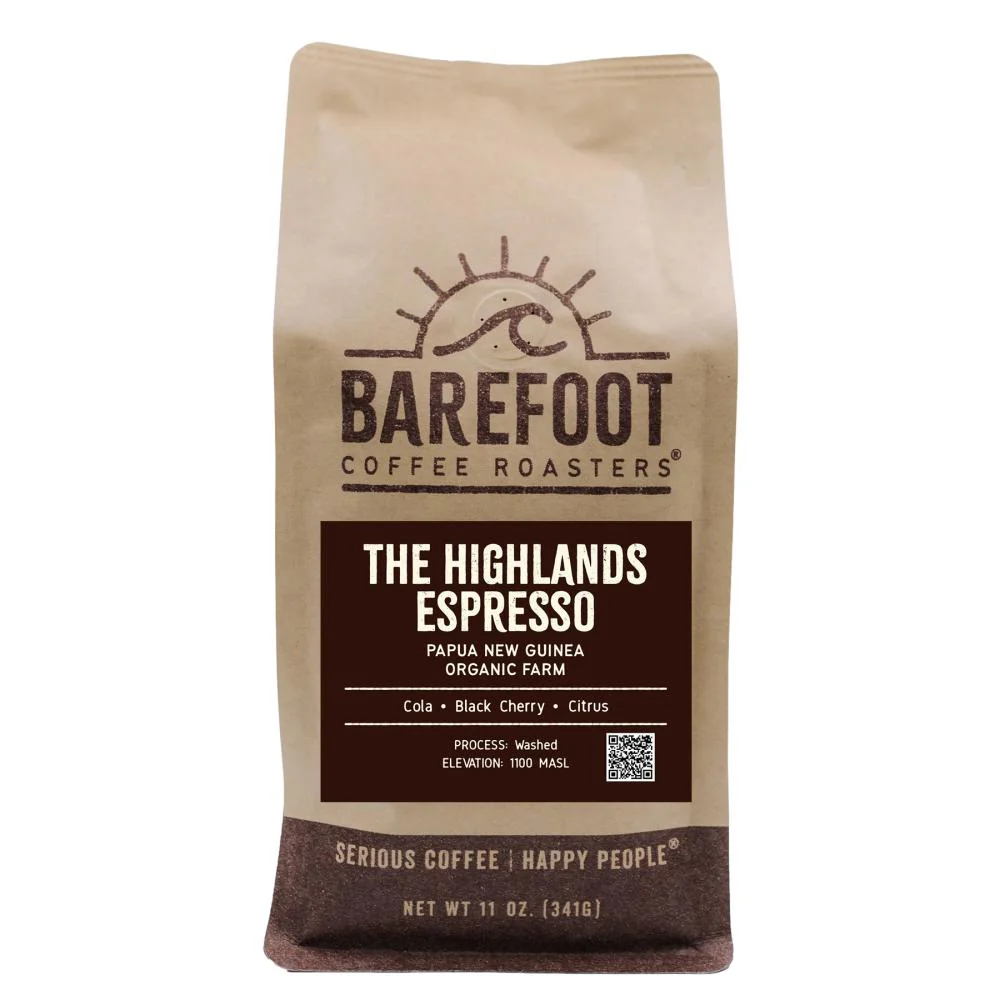
Highland Espresso
Coffee is a relative newcomer to Papua New Guinea considering that the commercial coffee production in the country dates back to 1926/1927 when the first Jamaica Blue Mountain seeds were planted. Making up a share of approx. 70% the coffee production is largely characterized by small farmers with land holdings that grow as little as 20 trees per plot in so called “coffee gardens” alongside subsistence crops. The country is generally dominated by fragmented mountain ranges, steep valleys and plateaus that are difficult to access.
Since many of the smallholder farmers live in such remote places, their coffee must be picked up by airplanes on grass landing strips, or for those lucky enough to have road access, it must be trucked to the nearest town - often struggling with broken axles from the trip.
The typical village-based grower in PNG uses no synthetic fertilizer or chemical pesticides. Leaf-fall from trees which shade it, together with the skin and pulp of freshly processed crop provide natural and nutrient-rich mulch. In order to process this coffee the farmer uses either their own small hand-operated pulping machine, or brings their coffee cherries to central washing stations.
Original: $25.75
-70%$25.75
$7.72Product Information
Product Information
Shipping & Returns
Shipping & Returns
Description
Coffee is a relative newcomer to Papua New Guinea considering that the commercial coffee production in the country dates back to 1926/1927 when the first Jamaica Blue Mountain seeds were planted. Making up a share of approx. 70% the coffee production is largely characterized by small farmers with land holdings that grow as little as 20 trees per plot in so called “coffee gardens” alongside subsistence crops. The country is generally dominated by fragmented mountain ranges, steep valleys and plateaus that are difficult to access.
Since many of the smallholder farmers live in such remote places, their coffee must be picked up by airplanes on grass landing strips, or for those lucky enough to have road access, it must be trucked to the nearest town - often struggling with broken axles from the trip.
The typical village-based grower in PNG uses no synthetic fertilizer or chemical pesticides. Leaf-fall from trees which shade it, together with the skin and pulp of freshly processed crop provide natural and nutrient-rich mulch. In order to process this coffee the farmer uses either their own small hand-operated pulping machine, or brings their coffee cherries to central washing stations.